Preface.
What follows is not a complete discussion of hexameter verse, but a utilitarian
guide to the first principles of recitation. As such, some liberties
have been taken for the sake of clarity; but with these principles
in mind, students should be able to approach with some confidence the daunting
prospect of reading Latin epic aloud.
Although the examples are from Vergil, the same rules of meter apply to Lucretius. The Tradition of
the Dactylic Hexameter. Before plunging into the
technical details, a few introductory words are in order. Greek and
Latin poems follow certain rhythmic schemes, or meters, which are
sometimes highly defined and very strict, sometimes less so. Epic
poetry from Homer on was recited in a particular meter called the dactylic
hexameter. It is fair to say that the dactylic hexameter defines
epic. That is, it is impossible to conceive of an epic poem not
composed in hexameters; and the hexameter rhythms, when heard, signal
that the poem being recited is an epic of some sort. (It is true
that in Homer's era, epics were more sung than recited, to the accompaniment
of a lyre. This was not the practice in Vergil's day, when the spoken
word was preferred.)
Fingers.
The word dactylos is Greek for "finger" (and for "toe" as well,
which picks up on the notion of feet, below). The dactyl
is therefore a snippet of rhythm that resembles, at least aurally, a finger.
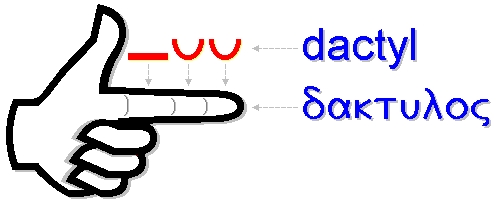
It has a rhythmic shape consisting of one long syllable (noted as ),
which represents the long bone, or phalanx, of the finger, plus two short
syllables (), which represent
the two short phalanges. Figure A will illustrate the concept better
than any further remarks.
Figure
A. The finger-like (dactylic) shape of the dactyl.
In rhythmic terms, the two short syllables are equivalent in tempo to the
long syllable, just as in music two half notes equal one whole note (or
two eighths equal one quarter, and so on). In recitation, the dactyl
usually sounds like "dum-diddy," with "dum" equal to ,
and "diddy" to .
Feet.
The dactyl serves as the basic rhythmic unit, or metron, of hexameter
verse. The word hexameter also derives from Greek and essentially
means "six metrons (or, to be precise, metra) in a row." In
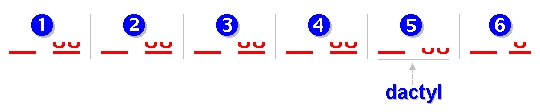
other words, a single epic verse consists of six successive dactyls, as
Figure B shows.
Figure
B. Idealized hexameter verse.
Observe that the final metron is technically not a dactyl.
Its second syllable is called the anceps (Latin for "two-headed"),
which is noted either as
or . No hexameter
verse ends in ; in
its place one finds the anceps, which is either short or long—it does not
matter. In fact, for purposes of recitation, the anceps is always
treated as long to fill out the line.
A more common word for metron is foot, the idea behind this term
being that a line of metra marches past one's ear during recitation.
Accordingly, the long syllable, which is the first half of the foot, is
called the thesis (Greek for "putting down") because the foot is
imagined as touching the ground; the two short syllables are therefore
called the arsis (Greek for "lifting up"), the half in which the
foot is raised up...for the next "footstep."
Substitution.
The general idea, therefore, is that a poet composes a hexameter verse
by placing words into the metrical scheme wherever they best fit.
One potential problem is that not every word has one short syllable, let
alone two. What to do, then, with words that have only long syllables?
The answer is that the meter must become more flexible. Specifically,
the poet, at his or her license, may replace (or contract) the pair
of short syllables in the arsis with (or into) a long syllable:
for . The foot is no
longer a dactyl, but a spondee:
for . The term spondee
derives from the Greek spondê, which means "libation";
spondaic feet, because of their stately, "dum-dum" rhythm, often occurred
in songs at solemn drink-offerings.
So every foot in a hexameter verse has the potential to be either a
dactyl or a spondee. Figure C illustrates this notion.
Figure
C. Idealized hexameter verse, with spondaic contractions.
Note that the fifth foot is depicted as a pure dactyl. This is not
to say that it may never be a spondee, but that it is rarely spondaic—only
when the poet desires (say) some kind of solemn effect.
Scansion Theory.
The term scansion (from the Latin scandere, "to move upward
by steps") refers to the process—some would call it an art—of dividing
a verse into its metrical components. It also called scanning.
This process is different from actual recitation, which seeks to preserve
both sound and sense along with rhythm; in scansion the primary concerns
are to determine whether syllables are long or short and to group them
into feet. (Remember that a syllable is a unit of uninterrupted sound
in a spoken language. For more on syllables, see below on syllabification.)
Scanning is good preparation for recitation, but with practice one can
easily recite and scan simultaneously.
Here are three rules-of-thumb for determining whether syllables are
long or short.
A short syllable contains a short quantity vowel, such as
the nominative singular ending of the first declension: .
A long syllable contains a long quantity vowel, such as the
ablative singular of the first declension: .
A long syllable may also contain a diphthong (two vowels
pronounced together), such as the genitive singular of the first declension: .
The -au- in nauta is also considered long under this rule.
In all of the above examples, the syllables are short or long by nature;
that is, the Romans naturally pronounced them as such, having learned their
vowel quantities during the process of acquiring Latin. What this
means for students new to the language is that quantities must be memorized
or checked in a glossary or dictionary (no small task either way).
Fortunately, there is often a way of circumventing the issue via one
more rule:
A syllable is considered long when directly followed by two consonants,
whether in the same word or beginning the subsequent word. For instance,
if the nominative immediately
precedes the verb scit, the final -a becomes long by position:
scit.
This rule is not ironclad, as certain consonant combinations—like -cr,
-pr, and -tr—will not "make position."
Basic Scansion.
Below is the first line of the Aeneid, scanned according to the
preceding four rules (Figure D).
Note that the theses of feet one and two are long by position. All
other syllables are either long or short by nature.
Note also that divisions between feet do not necessarily correspond
to those between words. So, for example, it takes an entire word
() plus part of another (-)
to comprise the first dactyl. Still, the last foot ()
is all contained within a single word.
Syllabification.
Drawing a line between feet often means drawing a line between syllables.
arma virumque cano, for example, is broken up as arma vi | rumque
ca | no. But why not arma vir | umque can | o? For
the answer one must remember the basic rules for syllabification,
or dividing words up into their syllables.
Syllables are usually divided between a vowel and a single consonant:
vi-rum, not vir-um.
When a vowel is followed by two consonants in the same word, the divison
comes between the consonants: ar-ma, not arm-a
or a-rma.
The exception to this rule when a vowel is followed by a stop
(a consonant formed by complete air blockage, e.g. t, d,
p, b, k, g) plus a liquid (a consonant
that can be prolonged, e.g. l or r).
So patres divides as pa-tres, not pat-res.
A stop-liquid combination, as a matter of fact, will not "make position"
for a vowel: the -a- in patres scans as short, not long.
Elision.
The contraction of dactyls into spondees, we have seen, provides a certain
flexibility, allowing more opportunities for word placement within a verse.
Sometimes syllables were ignored altogether through a process called elision
(Latin for "knocking out"), which ensured further flexibility. The
first rule of elision is as follows:
A final syllable ending in a vowelmay be omitted from the
meter before a word beginning with a vowel (or an h-).
EXAMPLE: The phrase
is technically three syllables long; but because est begins
with a vowel and nauta ends with one, the final -a is elided—"knocked
out," ignored—for a total of two syllables:
(pronounced something like "now test").
Note how the rule states that the syllable may
be omitted: it need not always be. The term for deliberate
avoidance of elision is called hiatus (Latin for "gap").
The second rule of elision is much the same as the first:
A final syllable ending in the letter -mmay be omitted from
the meter before a word beginning with a vowel (or an h-).
So is elided to
(again, "now test").
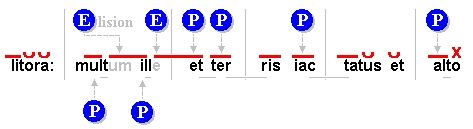
Figure E illustrates both rules at work within Aeneid 1.3.
As the presence of two audio files indicates, there are two schools
of thought regarding elided syllables in recitation: they are either
pronounced very lightly or completely suppressed.
Recitation.
Thus far the readings in the audio files have been very mechanical:
strong theses followed by light arses (DUM-diddy), all in strict tempo.
They must be so for the sake of theory. In practice, however, the
hexameter verse is much more resilient and allows for some license on the
reader's part: pauses, for example, or quickening of tempo can lend
great dramtic effect.
In fact, there are points in every line where strict meter will not
do. These tend to come at the beginning of a line, when the stress
placed upon the thesis conflicts with the natural accentuation of a word.
For example, cano in Aeneid 1.1; the word is naturally
accented on the first syllable: CA-no. But observance
of the meter requires the unnatural pronunciation ca-NO, which would
have made any good Roman cringe. Note, however, that meter and nature
combine toward the end of the line. After the fourth foot, primus ab oris (PRI-mus ab O-ris)
reads both metrically and naturally.
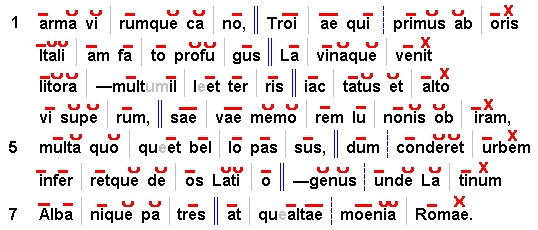
Figure I offers the first seven lines of the Aeneid in full scansion.
Note that all principal caesurae are marked, as are bucolic diaereses,
when they occur.
A few words on Professor Sonkowsky's reading. You will note first
and foremost his painstaking attempts to recapture authentic Latin pronunciation,
for instance urbem in verse 5, which sounds as if it ends in a nasalized
-n. But beyond sheer vocal pyrotechnics, note his somewhat loose
adherence to meter: his short syllables are indeed short, but are
not always of even tempo. Finally, although he pauses for caesurae,
he rarely offers full pauses at the ends of verses. Rather, he tends
to read sentence by sentence. So at the end of verse 2 he proceeds
directly to litora in 3, which is the object of venit in
the previous line. (This brief recording is made available on-line
by kind permission of Professor Sonkowsky and Audio-Forum,
a division of Jeffrey Norton Publishers, Inc. The recording is taken
from Sonkowsky's Selections from Vergil, a two-cassette volume in
Norton's Living Voice of Greek and Latin Literature series.)
A Final Word. When
learning how to read in meter, it is better to read mechanically at first, just
to get a sense of the rhythm. In time, the ear becomes more discerning,
and one's readings become more sensitive and sophisticated. The key, of
course, is practice...or as Vergil wrote, labor omnia vicit (Georgics
1.145).
 ),
which represents the long bone, or phalanx, of the finger, plus two short
syllables (
),
which represents the long bone, or phalanx, of the finger, plus two short
syllables ( ), which represent
the two short phalanges. Figure A will illustrate the concept better
than any further remarks.
), which represent
the two short phalanges. Figure A will illustrate the concept better
than any further remarks.

 or
or  . No hexameter
verse ends in
. No hexameter
verse ends in  for
for  . The term spondee
derives from the Greek spondê, which means "libation";
spondaic feet, because of their stately, "dum-dum" rhythm, often occurred
in songs at solemn drink-offerings.
. The term spondee
derives from the Greek spondê, which means "libation";
spondaic feet, because of their stately, "dum-dum" rhythm, often occurred
in songs at solemn drink-offerings.
 .
. .
. .
The -au- in nauta is also considered long under this rule.
.
The -au- in nauta is also considered long under this rule.

 ) plus part of another (
 -)
to comprise the first dactyl. Still, the last foot (
-)
to comprise the first dactyl. Still, the last foot ( )
is all contained within a single word.
)
is all contained within a single word.
 is technically three syllables long; but because est begins
with a vowel and nauta ends with one, the final -a is elided—"knocked
out," ignored—for a total of two syllables:
is technically three syllables long; but because est begins
with a vowel and nauta ends with one, the final -a is elided—"knocked
out," ignored—for a total of two syllables:  (pronounced something like "now test").
 is elided to
  (again, "now test").